Why Two Well-Chosen Matching Sets Beat Five Mediocre Ones
A closet with five different matching sets in five different fits, fabrics and colors often creates more morning decision friction than a closet with two sets that are genuinely reliable, since ‘having options’ only helps when every option is actually good.

Why Owning Too Many Mismatched Sets Creates More Decision Friction Than Owning Too Few
The friction math: the five-sets-in-five-different-fabrics-means-five-different-comfort-levels (the inconsistent fabric quality across sets producing a different experience every single time — the inconsistent-comfort-across-sets), the the-mornings-become-a-mini-decision-about-which-set-actually-works-today (the getting dressed turning into evaluating multiple imperfect options rather than grabbing a known-good default — the mini-decision-every-morning), the the-a-genuinely-reliable-two-set-rotation-removes-that-evaluation-entirely (the having only sets that are all equally good removing the need to evaluate at all — the reliable-rotation-removes-evaluation), and the reframe (more mismatched options creating more friction, not less — the reliable two-set rotation actually reduces the daily decision more effectively than a large uneven collection)).

The Specific Criteria That Make a Set Worth Repeat-Buying
What to actually evaluate: the fabric-holds-up-after-repeated-washing (the set maintaining shape, color and compression after many wash cycles rather than degrading quickly — the durability-after-washing), the the-fit-works-across-the-activities-you-actually-do (the set functioning for the specific range of workouts a person actually does, not just one narrow use case — the fit-across-actual-activities), the the-you-reach-for-it-without-thinking-twice (the genuine test being whether a set gets grabbed automatically rather than considered and passed over — the reach-for-it-automatically), and the frame (durability after washing, fit across actual activities, and being the automatic grab — three concrete criteria that separate a set worth repeat-buying from one that just seemed good in the store).
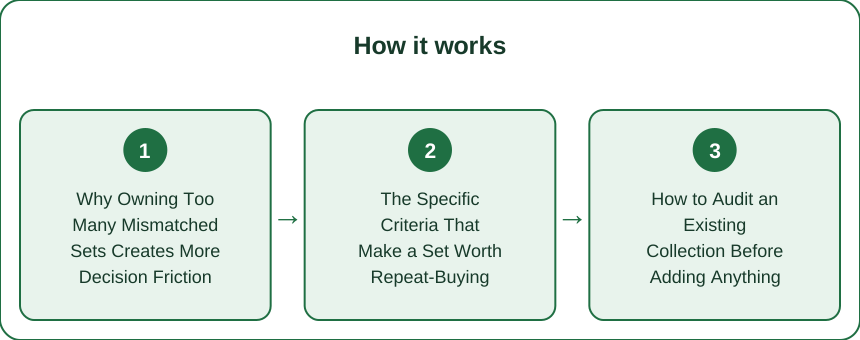
How to Audit an Existing Collection Before Adding Anything New
The practical audit process: the lay-out-every-set-currently-owned-at-once (the physically seeing the full existing collection rather than shopping from memory of what’s in the drawer — the see-the-full-collection-at-once), the the-sort-into-reach-for-it-and-avoid-it-piles (the honestly categorizing each set by whether it actually gets worn or sits unused — the sort-by-actual-use), the the-only-shop-to-replace-or-reinforce-the-reach-for-it-pile (the buying decisions targeting more of what already works rather than adding new variety for its own sake — the buy-to-reinforce-not-diversify), and the frame (laying out the full collection, sorting honestly by actual use, and shopping only to reinforce what already works — an audit that usually reveals two or three sets are doing all the real work already).
A closet with five mismatched matching sets in different fits and fabrics often creates more morning decision friction than one with two genuinely reliable sets, since inconsistent comfort across sets turns getting dressed into a small daily evaluation rather than a grab-and-go default. A set is actually worth repeat-buying if it holds up after repeated washing, fits the specific range of activities a person actually does, and gets reached for automatically rather than considered and passed over. Audit an existing collection by laying out every set currently owned at once, sorting honestly into a reach-for-it pile and an avoid-it pile, and shopping only to reinforce or replace what’s already in the reach-for-it pile rather than adding variety for its own sake.
Keep Reading
This article is for general informational and styling purposes only. Fit, sizing, and product availability may vary.